Lucentive

Lucentive · Enterprise AI

Engineering theIntelligent Enterprise.

Enterprise AI becomes useful when intent, review, approval, context, lifecycle, and team structure move together. Lucentive designs that operating model for large and regulated enterprises, using a methodology built for the constraints those environments actually run on.

What we hear inside enterprise AI programs

  • C-suite, regulated enterprise

    My demos work. The moment the rest of the org gets involved, everything slows to whatever review or approval step has not been redesigned.

  • Chief AI Officer, regulated enterprise

    We have an AI strategy on a slide. We do not have an operating model around it. Every team is running its own version of the same redesign work, in parallel.

  • VP Engineering

    Two of my engineers already ship at velocities the rest of engineering does not approach. The lessons they carry never move between teams.

Three different complaints, one structural cause. Most enterprises have AI tools and AI pilots. They do not have an AI operating model. That is the thing every leg of delivery is supposed to sit inside. The body of the methodology is six pairs that name what the operating model has to hold against, and what Enterprise OS holds in place.

The complexity is shifting left.

The most expensive AI mistakes are not bad models. They are agents running beautifully against the wrong thing. Business hands a document to engineering, engineering interprets it weeks later, and the leverage AI made available collapses inside that gap. The leverage point is at the front: intent quality, whether the workflow should exist in its current form, the business in the room while the system takes shape.

The pattern is a playbook, not a single-team result — same scope, same complexity, repeatable shape.

Door

Front-of-Process Engagement

Two halves. Install intent and intake quality so problems enter the chain with scope, references, and a readiness check before any agent run starts. Install a co-build cadence with the business in the room during the build, with same-afternoon iteration as the working mode.

Start the engagement
The slowest step sets the pace.

AI lets a small team produce code at velocities the rest of the delivery system was never built to keep up with. Most leaders watch two legs: compliance backlog and model updates. There are at least seven, including security review, infrastructure provisioning, deployment approval, context maintenance, and ownership boundaries. The weakness in any one of them caps the program.

Earned under regulated-production constraints: AI-assisted engineering moving through review, audit, and approval boundaries.

Door

Operating Model Diagnostic

Fixed-scope advisory. We walk the chain end-to-end against your program, name every leg, identify the step currently setting the ceiling, and write down the next concrete change worth making. Ready to run from Monday morning — not a deck.

Start the diagnostic

The outcome is only as good as the context.

AI output is bounded by what context the system can reach. Better retrieval over uncurated context still produces weak results. The constraint is not the model. Most enterprises are re-explaining the same project, standards, and decisions on every agent run, paying for each re-explanation in tokens and in output quality.

Earned under regulated-production constraints: a context layer authored once, validated alongside every agent step, reused across workflows.

Door

Context Architecture Engagement

We pick one workflow and design its reusable-context layer end-to-end. Automated checks run alongside every agent step from week one. The same pattern is ready to apply to the next workflow when you are.

Start the context engagement

What strong developers know becomes shared infrastructure.

Strong individual AI leverage already exists inside most large organizations. Two engineers are shipping at velocities the rest of the team cannot approach. What does not exist is the mechanism to move that capability across teams. Shared agent setups live in personal environments and travel with people, not with the organization. Hiring more strong individuals compounds the inequality. It does not close the gap.

One team proving the pattern is a result. Many teams running the same pattern is a transformation.

Door

Capability Propagation Program

Quarter-scale advisory. We sit with your strongest AI-assisted developers, write down the practice they carry, run it across two or three additional teams, and install a measurement loop the organization keeps running after we leave.

Start the program

Production AI has to be operated, not just deployed.

Foundation models change underneath deployed systems. Tool APIs shift. Evaluation criteria drift. Most enterprises treat AI deployments as one-time builds and discover months later that the system in production is not the one they thought they had. Without standing capacity in place — owners, budget, cadence — every model update becomes a scramble, and every other discipline degrades on the same clock.

Validated in live regulated-production work: lifecycle inventory, named owners, model-update cadence — installed as standing work, not a one-off cleanup.

Door

Lifecycle Engagement

Quarter-scale advisory wrapped around an existing AI program. We install a lifecycle inventory, name owners for each system, set the cadence for model updates and context-layer review, and define the path from new model version available to every dependent system re-validated.

Start the engagement

Controls, approval, and audit are embedded, not sequenced.

The default enterprise reflex is to sequence controls behind capability: stand up the platform, prove it works, layer review on top. This holds at pilot scale and breaks at production scale. The first time something ships fast, the system collapses to ad-hoc review. When a regulator asks what the AI did last quarter, the answer becomes a forensic reconstruction project rather than a query against a record that was already kept.

In regulated production: controls, approval gates, and a durable record of every run, embedded from day one rather than bolted on.

Door

Governance-Embedding Engagement

Install controls, approval, and audit as parallel-from-day-one mechanisms across the program. Automated checks embedded in every agent run. Approval gates at the boundaries that matter. A durable record of what context was used, what checks applied, and what the human reviewed — by default, not by exception.

Start the engagement

Lucentive IP

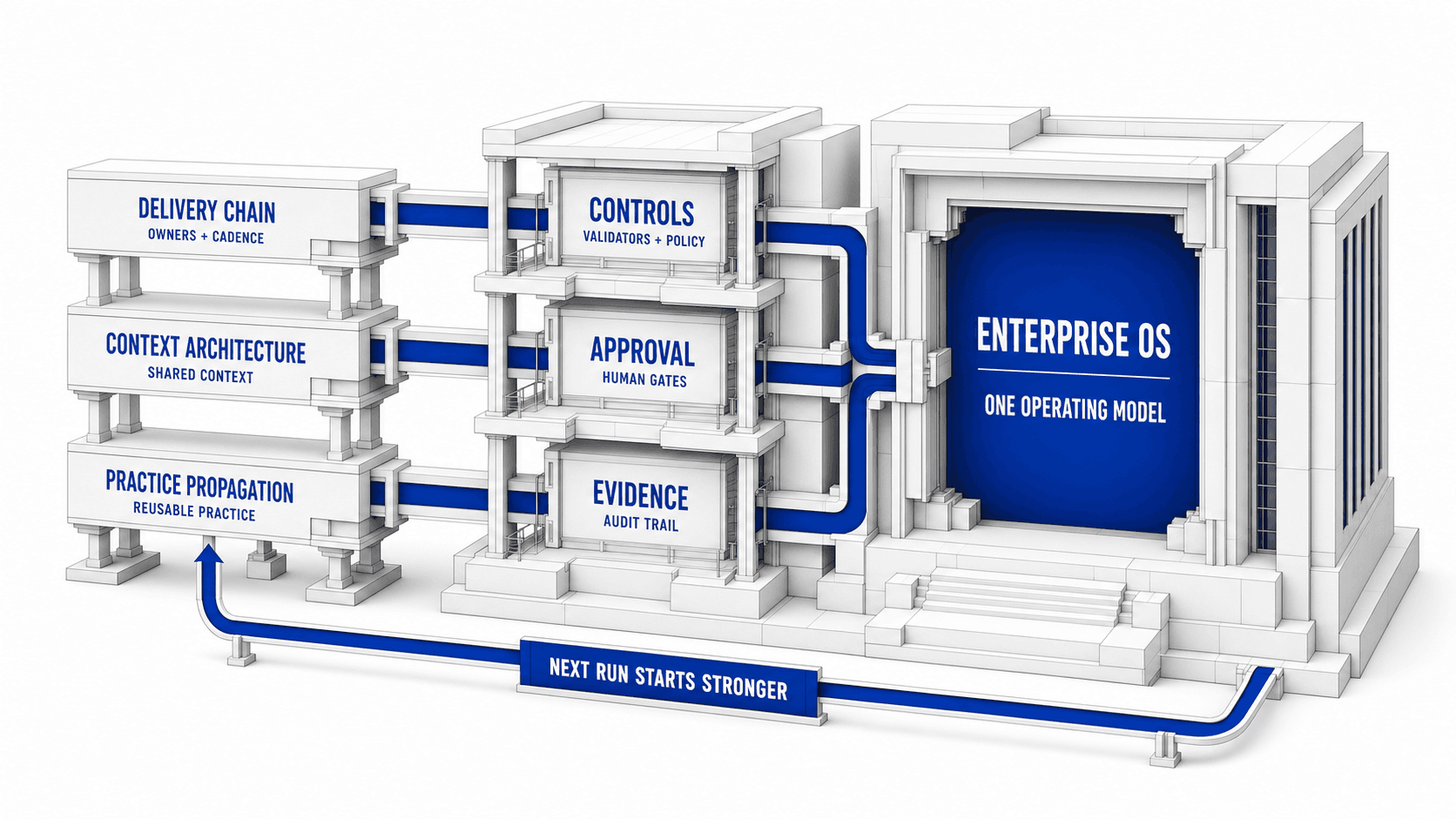
Enterprise OS. The methodology around AI delivery.

Architectural blueprint showing three input layers, three control gates, and a return loop feeding one Enterprise OS operating model.
Enterprise OS turns inputs, gates, and a return loop into one operating model for AI delivery.

Manage your Enterprise AI

Intuitive Agent System.

Beta
Our solution

IAS is the first software layer of Enterprise OS for engineering teams. It runs in your repo so teams can give agents the same brief, keep review close to the work, and see what happened after each run.

Some Enterprise OS engagements use IAS directly. Others install the same operating discipline around a different environment.

Repo-firstShared briefRun record
Visit ias.dev

Where the method becomes real

The proof sits close to the work.

Enterprise OS is shaped in delivery, written down as a method, and carried into software through IAS.

  1. 01

    Regulated production

    Founder-led regulated-production work is where the operating pattern is tested: real engineering work, senior review, audit, and approval in the same loop.

    Read the field proof
  2. 02

    IAS in software

    Intuitive Agent System (IAS) is the first part of the method shipped as software. It runs in the repo, keeps review near the code, and leaves a record teams can inspect.

    Visit ias.dev
  3. 03

    The method written down

    Enterprise OS turns field lessons into a practical method for how AI work enters the organization, how decisions stay attached, and what must be true before work reaches production.

    Read the Enterprise OS method
  4. 04

    Senior partner delivery

    7N and Globeteam join selected engagements when an assignment needs more senior delivery capacity than Lucentive fields directly.

    Start with the brief

Where to start

Where is AI getting stuck in your business?

Bring one real problem. We start with the failure mode and shape the first working engagement around it. Senior-led, fixed scope.